Home > Blog > 6-Color vs 10-Color UV Printers: Which One Is Right for Your Business?
6-Color vs 10-Color UV Printers: Which One Is Right for Your Business?
By Jingtong Intelligent TechnologyOctober 5th, 2026
When choosing a UV flatbed printer, one question often comes up: Should you choose a 6-color or 10-color configuration?
More colors can provide a wider color range and smoother image transitions, but that does not automatically mean a 10-color UV printer is the best choice for every business.
The right option depends mainly on what you print, the level of color accuracy your customers expect, production requirements, and your budget.
What Is a 6-Color UV Printer?
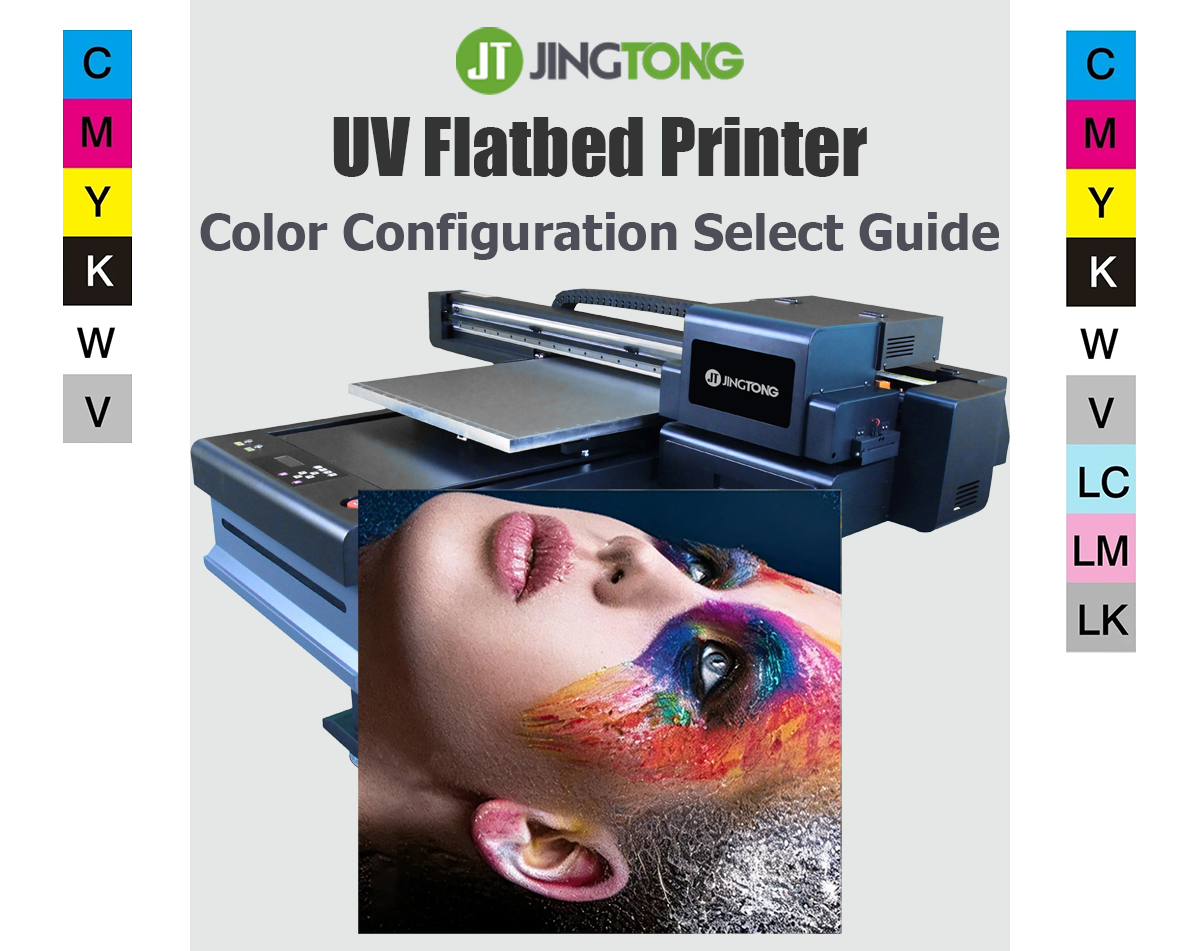
A typical 6-color UV printer uses CMYK + White + Varnish (W + V).
CMYK produces the main colors, while white ink allows printing on dark, transparent, and colored materials. Varnish can be used to add glossy finishes, highlights, and raised or textured effects.
For many commercial applications, this combination already provides excellent flexibility.
A 6-color UV printer can be used for:
Acrylic and glass
Wood and MDF
Metal and aluminum panels
PVC and plastic
Ceramic tiles
Phone cases and promotional products
Packaging and decorative products
For businesses printing customized products and signage, the ability to use white ink and varnish is often more important than having additional color channels.
What Is a 10-Color UV Printer?
A 10-color configuration normally adds light colors and additional specialty colors to the standard color set. Depending on the printer, these may include Light Cyan, Light Magenta, Light Black, Orange, Green, or other colors.
The main advantage is a wider color gamut and smoother color transitions.
This can be useful when printing:
Professional photography
Fine art reproductions
High-end commercial graphics
Detailed portraits
Premium packaging
Projects requiring very strict color matching
For these applications, subtle gradients, skin tones, and fine color differences can be especially important.
6-Color vs 10-Color: Which Should You Choose?
The simplest way to decide is to look at your actual business.
Choose 6 colors if: You mainly need a versatile UV printer for everyday commercial production.
If you print promotional products, signs, acrylic, glass, wood, metal, phone cases, packaging, or personalized products, a 6-color system can cover a wide range of applications.
It is also a good option if you want to keep the initial investment and ink consumption under control while still achieving high-quality results.
Consider 10 colors if: Your business focuses heavily on premium image reproduction and color-critical work.
If customers require highly accurate brand colors, photographic reproduction, smooth skin tones, or very subtle gradients, additional colors may provide an advantage.
However, the extra color channels also mean a more specialized setup and potentially higher operating costs.
Why Choose a 6-Color JT-UV 6090-3H?
For businesses looking for a versatile UV flatbed printer, the JT-UV 6090-3H offers a practical balance between print quality, flexibility, and investment.
Its 6090mm-class flatbed format provides a useful working area for a wide range of products, while the 6-color configuration supports CMYK + White + Varnish printing.
This means you can produce normal full-color images as well as white-ink and varnish effects without moving to a more expensive 10-color system.
The JT-UV 6090-3H is suitable for applications such as acrylic signs, glass, wood products, metal panels, promotional items, packaging, decorative products, and personalized gifts.
For businesses that want one machine to handle different products rather than focusing only on high-end photo reproduction, this balance can be more valuable than simply having more ink channels.
The Best UV Printer Is the One That Fits Your Work
More colors do not always mean better business results.
Before choosing a UV printing machine, consider:
What materials will you print?
What products will you sell?
Do you need white ink and varnish effects?
How important is exact color matching?
What production volume do you expect?
What is your equipment and running-cost budget?
For most general commercial UV printing, a well-configured 6-color printer can provide the right combination of color quality, special effects, versatility, and cost efficiency.
If you are looking for a flexible UV flatbed printer for different materials and customized products, the JT-UV 6090-3H is a practical option to consider.